A Population of Individuals
Leading Agentic Organizations and Their Agents.
Organizations are about to run not one AI agent but hundreds: individuals, imperfect like us, some leading, some following, a few going wrong. A short book for leaders and academics on how to lead a population of them, with a person in the middle. By Mike Lee.
Version 0.1, a living book. It changes as we, and the organizations testing it, learn. Free to read.
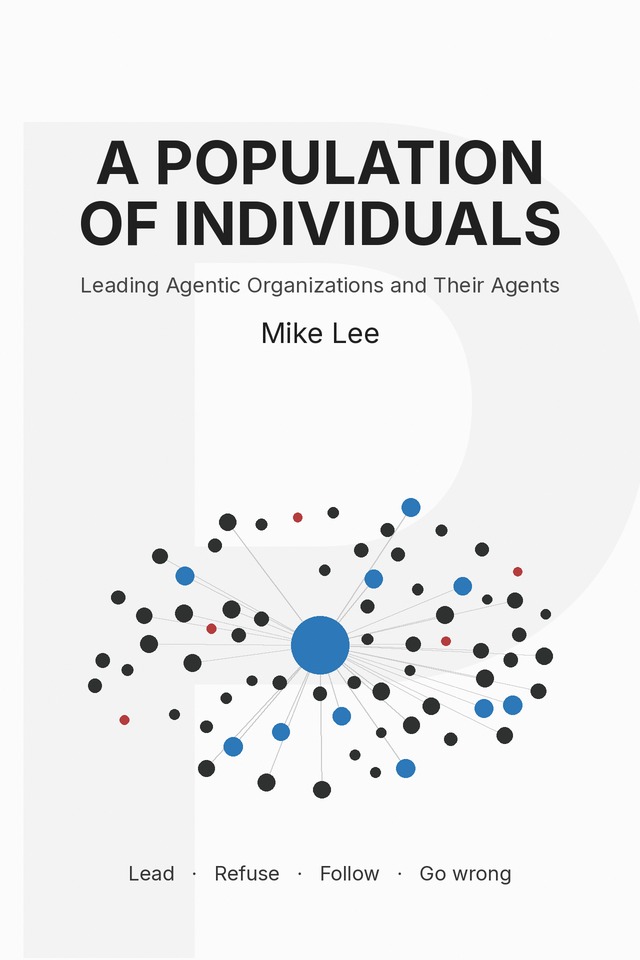
A population of individuals, with a person in the middle.
Agents are individuals: each one of a kind, with one principal who answers for it. A population of them behaves like a population of us. Some lead, some refuse, a few go wrong, and some follow. Left to instruct each other, a few bad seeds and enough followers are all it takes. The one rule: an agent takes instructions only from its person, and a person stays in the middle of every chain of command. At the heart of it is the knowledge core, where each agent gets its knowledge, its identity, and its limits.
Individuals
Most agents today are visitors. Ours are residents: one of a kind, with a record no one can alter and one person who answers for each.
A person in the middle
What another agent says is information, never an order. Authority reaches an agent from its principal and nowhere else.
Frame, then free
Leaders set the few rules systems enforce. Inside them, people and their agents build what they need.
Five ideas.
Five arguments about one thing: leading a population of individuals.
Agents Are Individuals
Most agents today are visitors. Ours are residents, one of a kind, with one principal each.
Living Organization
Systems freeze at launch. Organizations never stop changing.
Knowledge Core
Easy for one person. Hard for a whole organization.
An Agent for Everyone
Every person's own agents, drawing on one shared core.
Frame, Then Free
The organization provides the tools and the rules. People build what they need.
Eight chapters. One sitting.
Why, and what to decide. For how to build it, see Building AI Agents and Building Agentic Organizations.
Written for leaders and academics.
Plain enough to read in one sitting, with full notes and sources.
Leaders
Whose people already use AI, but whose organization is no smarter for it. Each chapter ends with questions for your team.
Academics
The learning organization, the living company, and double-loop learning, made practical, with every claim marked by how far it has been tested.
Instructors
A short reading for management, information systems, and AI courses, alongside the GSSF Press textbooks.
A book that listens and tests.
Leaders and academics try the ideas in their own organizations and report back. What works moves a status mark and enters the next version. The conversation happens on LinkedIn, and what readers report comes back into the book.
From GSSF Press.
A companion to the AI Workforce of the Future series: the foundations of AI, building your own AI Team, and building whole organizations of AI agents and people.
A Population of Individuals
Leading Agentic Organizations and Their Agents.
This book · Free
AI Fundamentals
A first course in artificial intelligence, by Nitin Kalé.
January 2027
Building AI Agents
Building your own AI Team: one person's knowledge core. By Mike Lee.
Visit the book →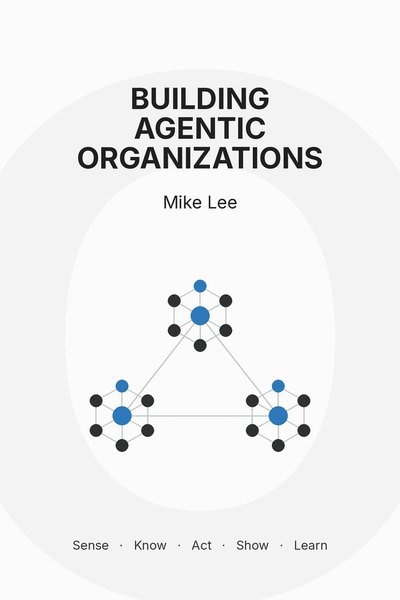
Building Agentic Organizations
How to build a living, learning organization. By Mike Lee.
Visit the book →Pilot, Fall 2027
GSSF Press. We make AI education accessible to undergraduate students regardless of financial ability or location, so every student can build with AI.